

The death toll from the floods along the Nepal-China border has crossed 1,000, with Nepal reporting 987 deaths and China 16. Nepal’s disaster management authorities said 11,814 people have been rescued, while thousands remain unaccounted for as rescue teams continue searching affected areas and hydropower tunnels. Meanwhile, Nepal has issued a fresh flood alert as water levels rise in several districts, raising concerns over further risks in the disaster-hit region.
Amid the ongoing crisis, Lighthouse Journalism found a few videos being shared widely on social media platforms as recent footage of the Nepal floods. However, an investigation found that the videos are either old, unrelated to the current floods, or AI-generated.
Claim:
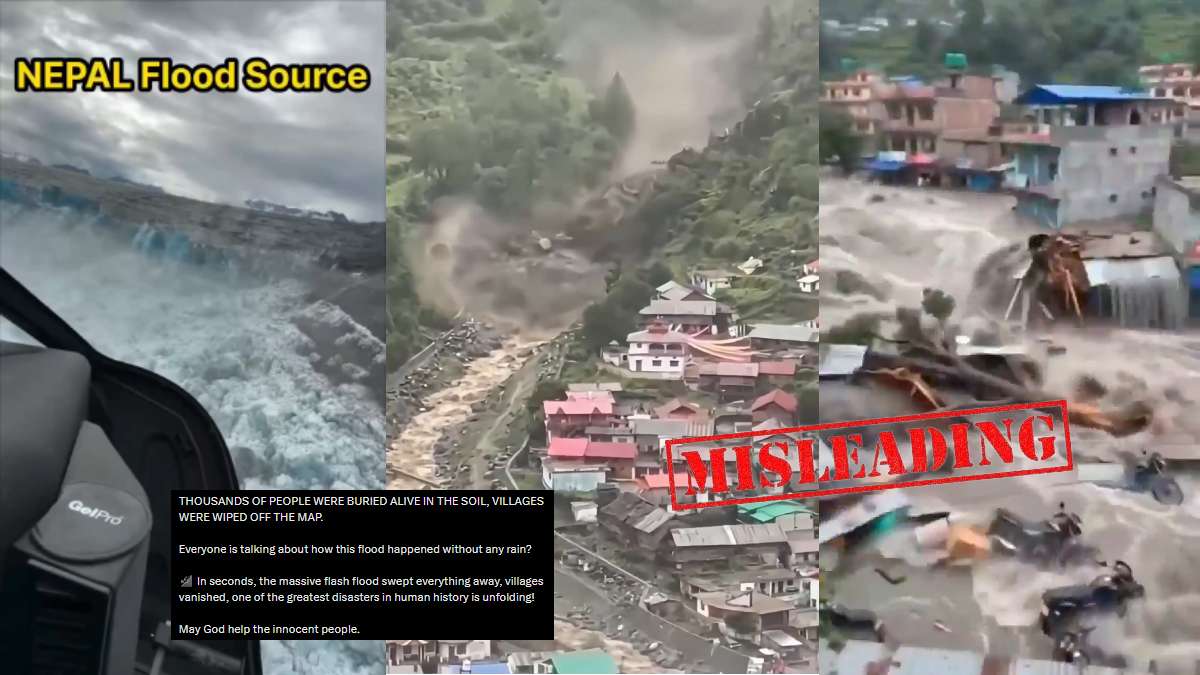
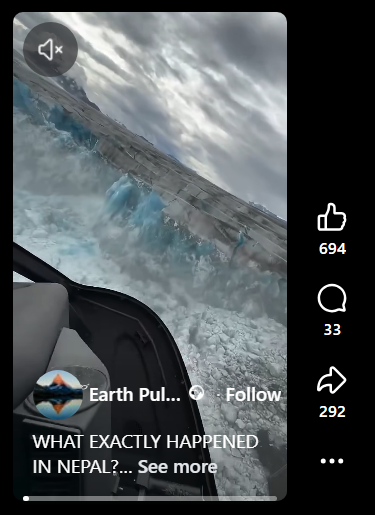
1. Instagram user “Tireless Students Hub” shared the viral video with misleading claim, “Witness the raw, untamed power of the Himalayas as a Glacial Lake Outburst Flood (GLOF) unfolds in real-time. This footage captures the sheer force of nature in Nepal, where an ice dam collapse unleashes a torrent, carving dramatic canyons and exposing brilliant blue glacial ice beneath the surface.”Other users also shared same video with similar claims.
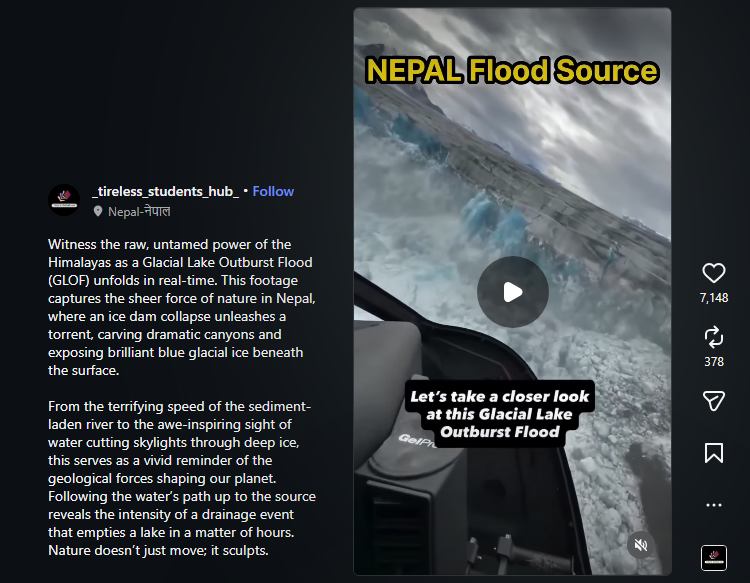
Other users have also been sharing same video with similar claim.
2. X user Said Ercan shared another viral video that featured flood water and debris sweeping the village away. This was a compilation of separate video clips.
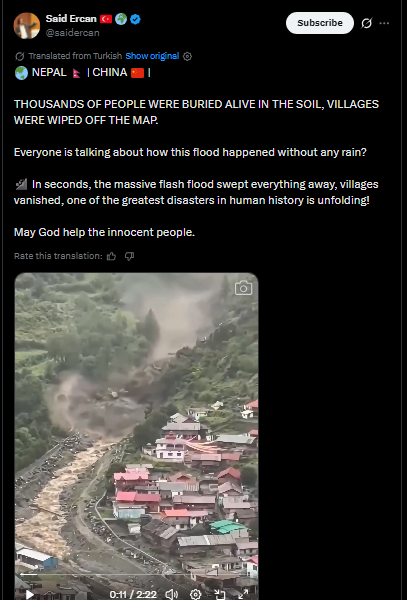
Other users also shared same video with similar claims.
3. X user Ravi Shankar Singh shared the viral video on his profile. The user claimed, “Watching the scene of this horrific devastation that has struck Nepal sends shivers down the soul; see in the video how people are trapped between life and death under the rubble, and in one place someone is searching for their loved ones by clearing the debris with their bare hands, while elsewhere the rescue team is engaged in the final effort to save lives.”
Other users are also sharing the same video with similar claim.
Investigation:
Claim 1: We started the investigation by downloading the Instagram video and extracting keyframes from the same.
We then ran a reverse image search on the keyframes obtained from the video.
Through this we found that the video was posted by an Instagram user “helipilotleigh” on August 21. The caption said: A Jökulhlaup, also known as a GLOF or Glacial Lake Outburst Flood, happens when water trapped by glacier ice suddenly finds a way out. The pressure can lift and fracture the ice, allowing the lake to drain rapidly beneath the glacier and rush downhill with incredible force.
This is a fairly common occurrence but rare to capture as they happen in very remote areas. This one on Columbia Glacier in Alaska has been occurring annually since 2014.”
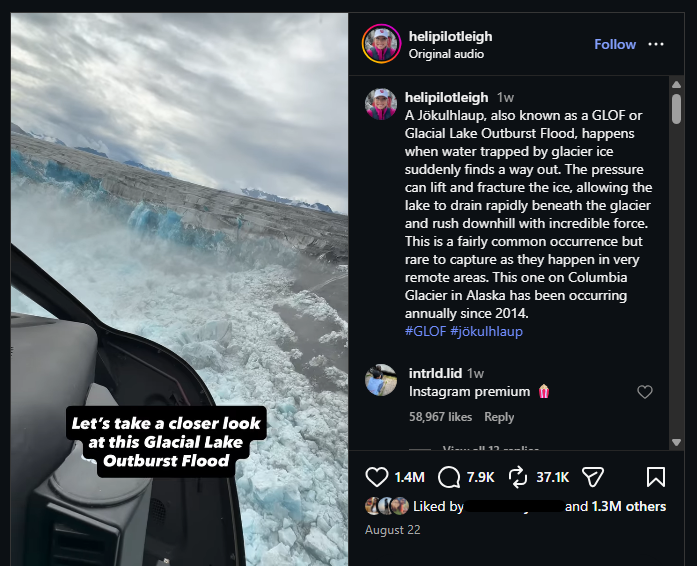
The user also replied to another social media user when asked, whether this was the lake which caused floods recently. To which the user replied that the video was from Alaska and not Nepal.
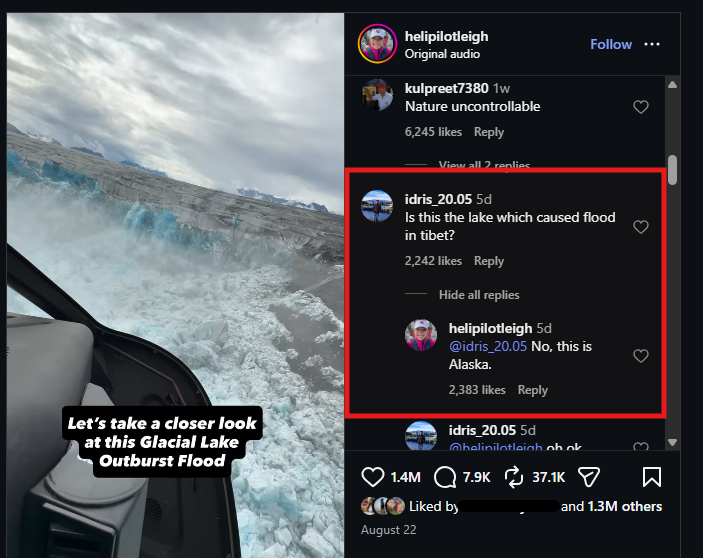
The video misleadingly featuring Glacial Lake Outburst linked to Nepal floods, was actually found to be from Alaska and not Nepal.
Claim 2:
In this video too we ran a reverse image search on the keyframes obtained from the viral video.
The search results informed that the video was from devastating flash floods and mudslide that struck Dharali village in Uttarkashi district of Uttarakhand on August 5, 2025.
We found several news reports featuring the viral video.
The Instagram page of Times of India too had carried the same video stating it featured, “#Uttarkashi cloudburst havoc: At least 4 dead as flash floods swallow homes, hotels in #Dharali; entire village washed away”
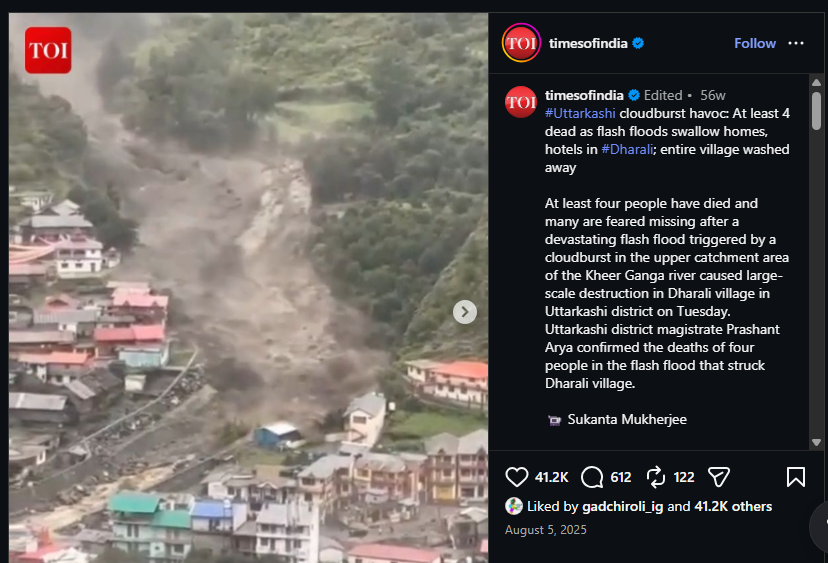
Henceit was clear that the viralvideo from Uttarkashi floods from 2025 shared with misleading claim as that of being from Nepal floods.
Claim 3:
Lighthouse Journalism found few discrepancies in the video and decided to run through an AI content detector.
AI content detector Human Meter suggested that the video was AI generated.
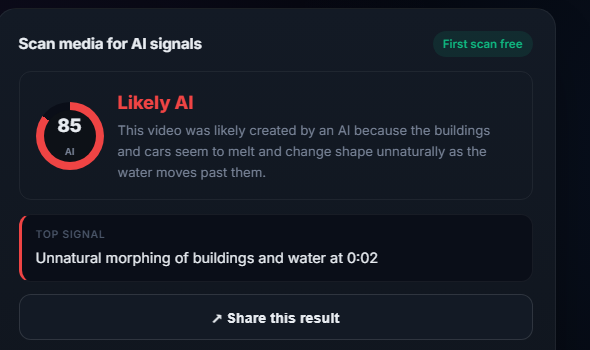
We also ran the screenshots from the video through Google’s Investigation Agent “Backstory.” The tool suggested that the image showed Gen AI patterns.

The result stated: Analysis of the input image and its copies found patterns consistent with AI image generation, suggesting this image may be AI generated or AI manipulated.
Conclusion: Lighthouse Journalism found that all three videos being shared with misleading claims linking them to the ongoing Nepal floods. While the first video was actually recorded at Columbia Glacier in Alaska and the second showed the 2025 flash floods in Uttarakhand’s Dharali village, the third video contained signs consistent with AI-generated or AI-manipulated content. Old, unrelated and AI generated videos were shared as recent with misleading claim.